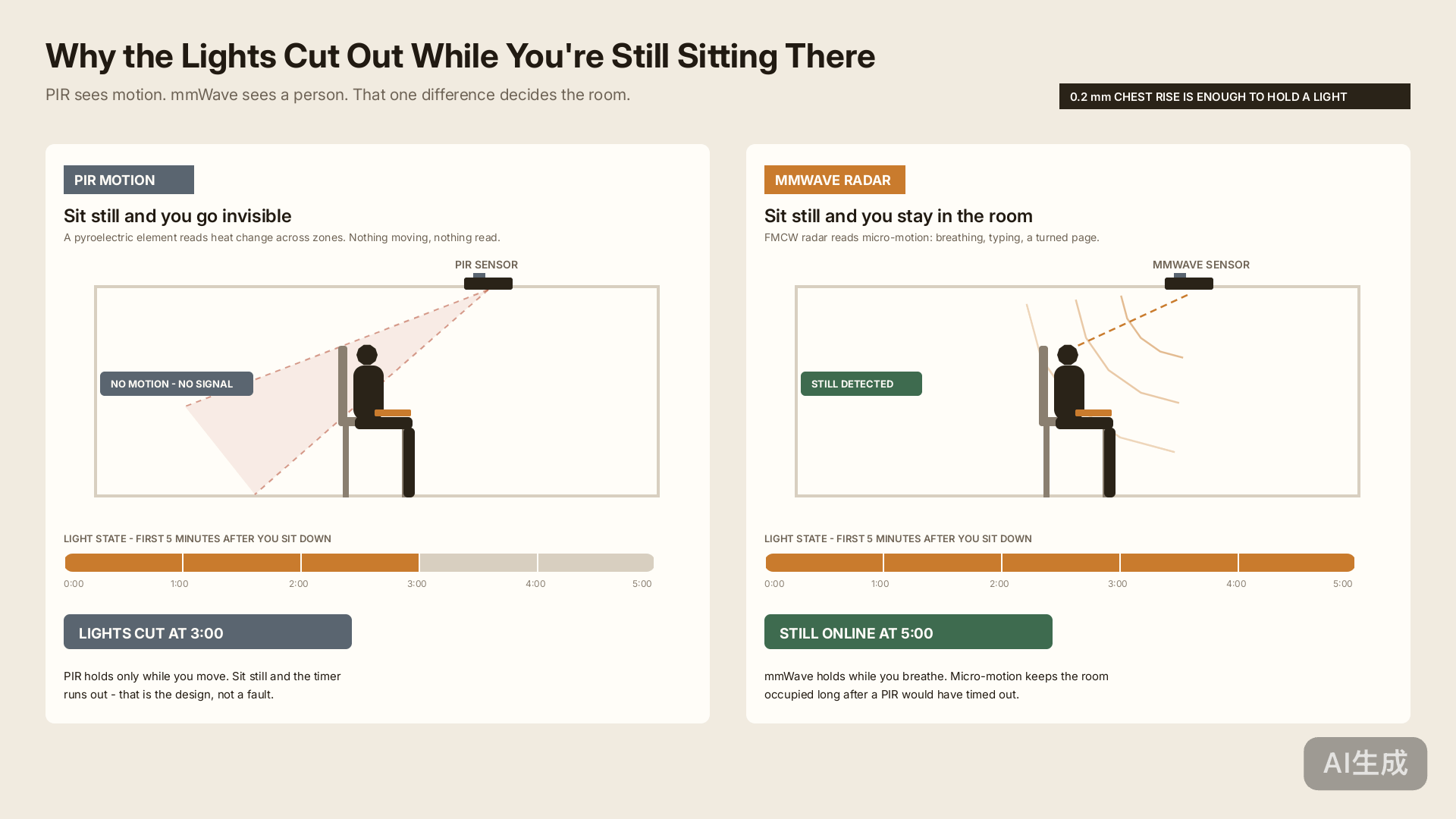
If your lights turn off while you’re still in the chair, that’s the sensor working as designed — PIR sees motion, not people.
Older motion sensors (PIR) detect changes in heat from a moving body. Walk in: lights on. Sit still to read, type, or watch TV: you go invisible, the timer runs out, the lights cut. Waving your arm to keep the lights on is the symptom, not the fix.
The newer option is mmWave radar. It reads micro-motion — breathing, typing, a turned page — so it knows the room is occupied even when you’re still. That single difference splits the buying decision:
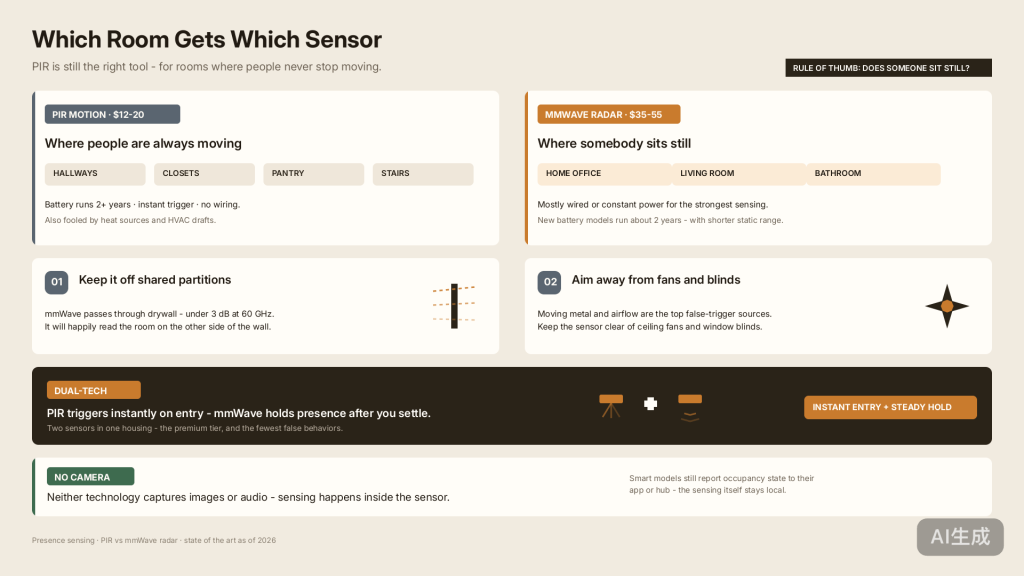
Where PIR is still the right tool ($12-20 typical US retail, battery runs 2+ years): hallways, closets, pantries, stairs — anywhere people are always moving. Fast trigger, cheap, wire-free.
Where mmWave earns its price ($35-55 typical, needs continuous USB/wired power): home offices, living rooms, bathrooms — anywhere someone sits still. No more mid-task darkness.
Dual-tech sensors combine both: PIR triggers instantly on entry, mmWave holds presence after you settle. Premium option, minimal false behavior.
Two placement notes: mmWave can read through thin walls, so keep it away from shared partitions to avoid triggering from the next room — and keep both types away from fans and metal blinds, which cause false triggers. Neither technology uses a camera; everything stays inside the room’s sensor.
Name the one room where lights turn off on you. That’s the room that needs mmWave.
作者

admin@exmaple.com
相关文章
Smart Switches vs Smart Bulbs: Count Your Bulbs Before You Buy Either
One wall flip from a g...