“25,000 hours” on the box isn’t a promise. Divide by 3 hours a day and it’s about 23 years — on paper.
The rated hours on a bulb box are a projection, not a countdown. Two things decode them:
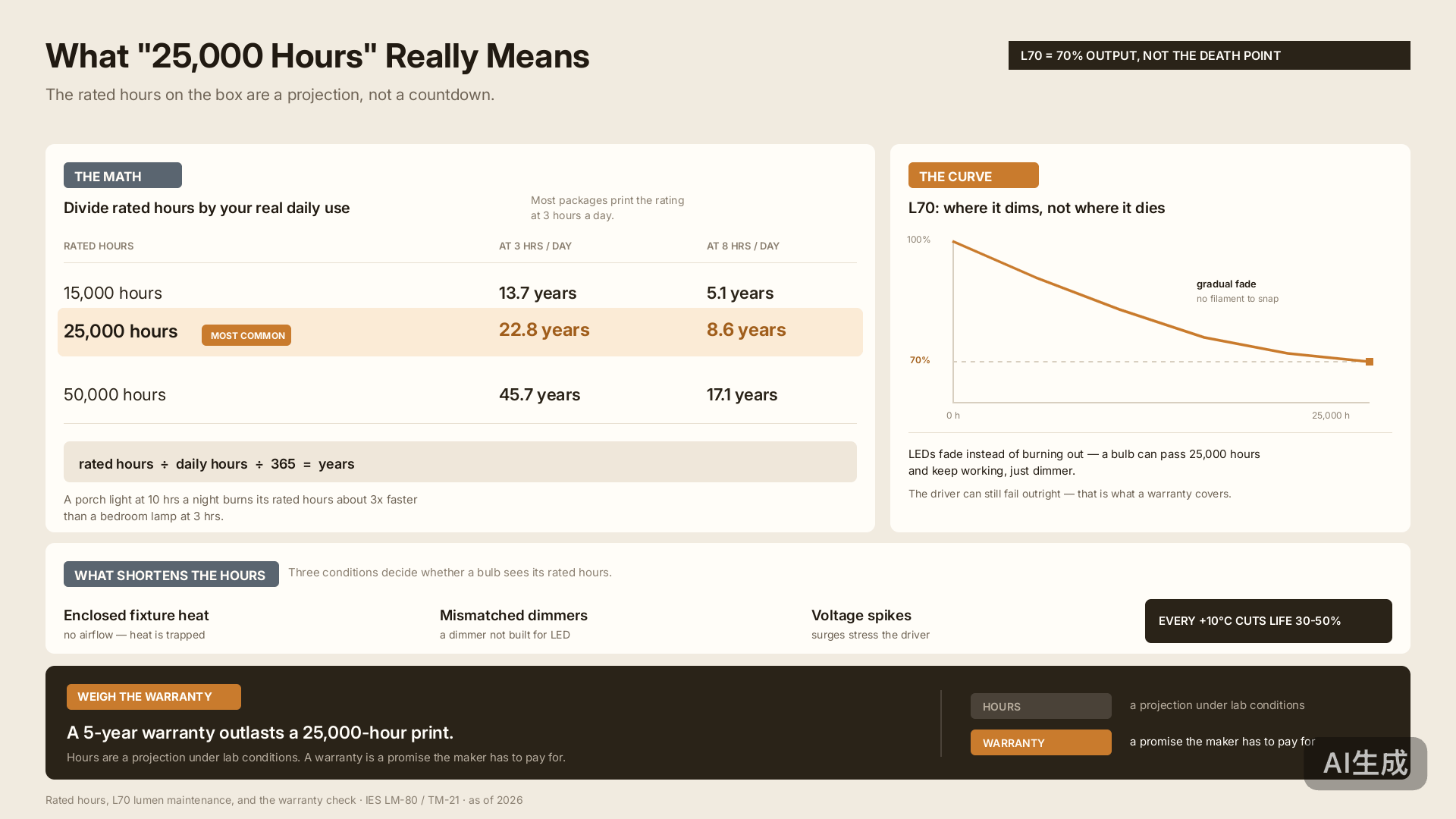
The hours-to-years table (rated hours ÷ daily hours ÷ 365):
- 15,000 hours = 13.7 years at 3 hrs/day · 5.1 years at 8 hrs/day
- 25,000 hours = 22.8 years at 3 hrs/day · 8.6 years at 8 hrs/day
- 50,000 hours = 45.7 years at 3 hrs/day · 17.1 years at 8 hrs/day
The fine print: L70. LED lifespan is usually defined as the point where output fades to about 70% of original brightness — not where the bulb dies. LEDs fade; they rarely burn out like filaments did. A bulb can pass its “lifetime” and keep working, just dimmer.
And the projection assumes lab conditions: stable voltage, open air, controlled temperature. Real homes shorten it. Heat in enclosed fixtures, mismatched dimmers, and voltage spikes are the three big accelerants. Realistic ranges from independent testing: quality bulbs in good fixtures often deliver 20,000-40,000 hours; cheap bulbs in hot, sealed fixtures can fall to 8,000-15,000.
Two checks worth doing:
- Do the division for your actual usage — a porch light burning 10 hours a night eats its rated hours 3x faster than a bedroom lamp.
- Weigh the warranty over the hours. A 5-year warranty is a bigger commitment than a 25,000-hour print, because it’s the manufacturer’s money on the line, not a projection.
作者

admin@exmaple.com
相关文章
Enclosed Fixture Rated LED Bulbs: What the Label Actually Means (and Where You Need It)
“Enclosed Fixture Rate...
CRI 80 vs 90: Where High-CRI Bulbs Are Worth It (And Where They’re Waste)
Your navy socks and yo...