
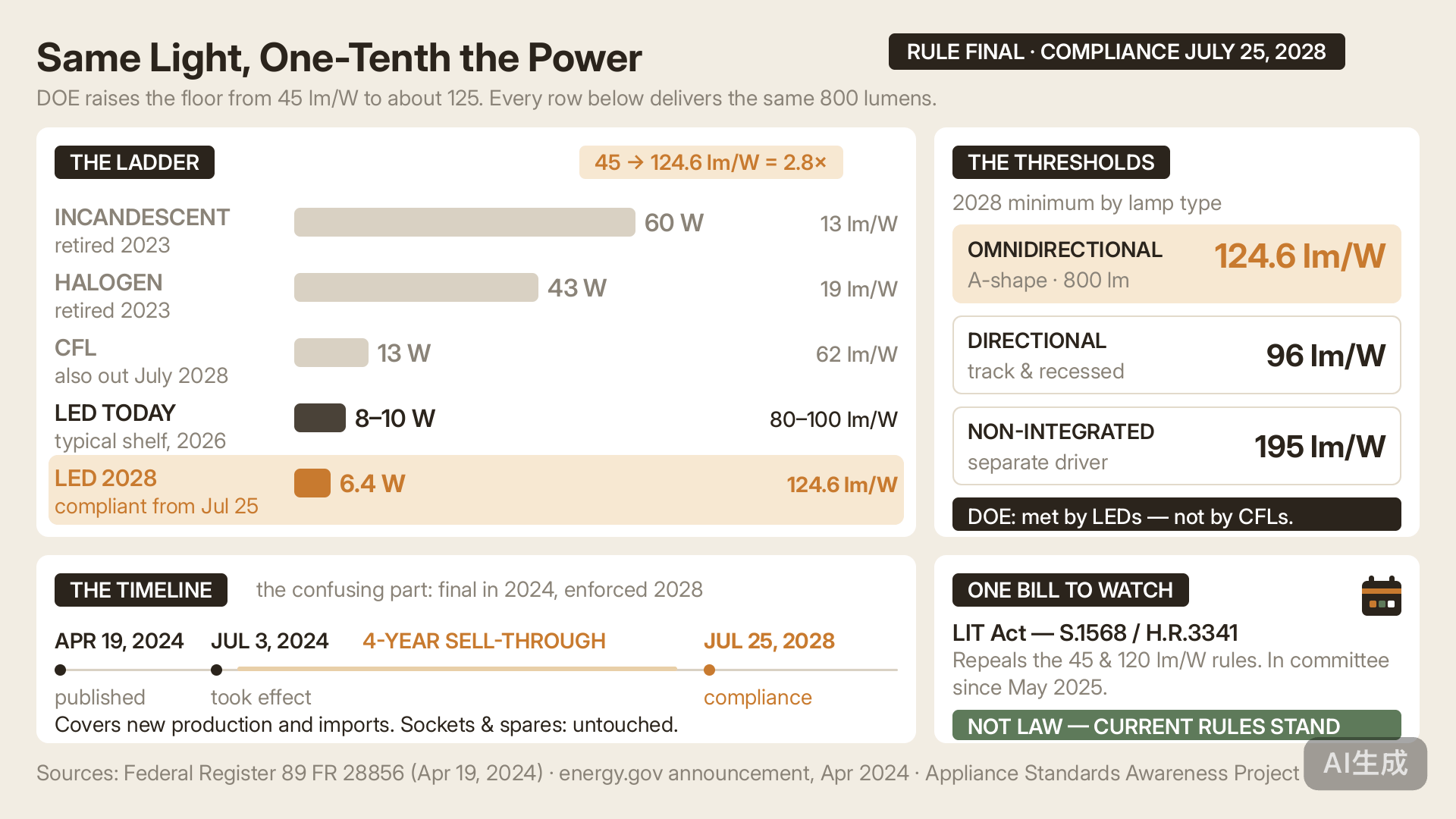
It’s final: from July 25, 2028, the most common light bulbs sold in the US must clear roughly 120 lumens per watt. Here’s what changes at the shelf.
The dates, so you can quote them right: DOE published the rule April 19, 2024, it took effect July 3, 2024, and manufacturer compliance is required on and after July 25, 2028. The standard raises the floor from 45 lm/W to more than 120 lm/W for the most common bulbs — for a standard 800-lumen bulb, that works out to about 125 lm/W.
What that means in practice:
What you already own: nothing changes. The standard applies to newly produced or imported bulbs. The bulbs in your sockets and your spare drawer are untouched.
What you buy after mid-2028: LED, effectively across the board. DOE’s own framing: the levels are met by a broad variety of widely available LED bulbs — and not by CFLs. A 60W-equivalent LED typically draws 8-10W today; a compliant one will need to do 800 lumens in about 6.5W. DOE estimates the standards save American families $1.6 billion a year on household energy costs.
The categories to watch: color-tunable, white-tunable, high-CRI, and decorative smart bulbs are the ones industry coverage flags as hardest to bring above the line — color tricks and color fidelity cost efficiency. If you rely on a specific oddball bulb, note the brand and model now so you can track what happens to it.
The habit worth building before 2028: divide lumens by watts on the Lighting Facts panel. An 800-lumen bulb drawing 9W is ~89 lm/W — fine today, and a number that will only climb.
作者

admin@exmaple.com
相关文章
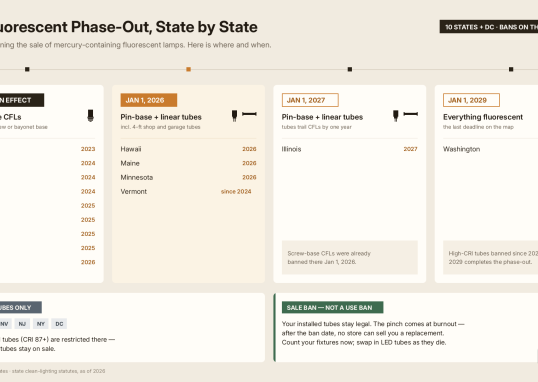
Fluorescent Light Bans by State: What Homeowners Can Still Buy in 2026
Ten states now restric...