
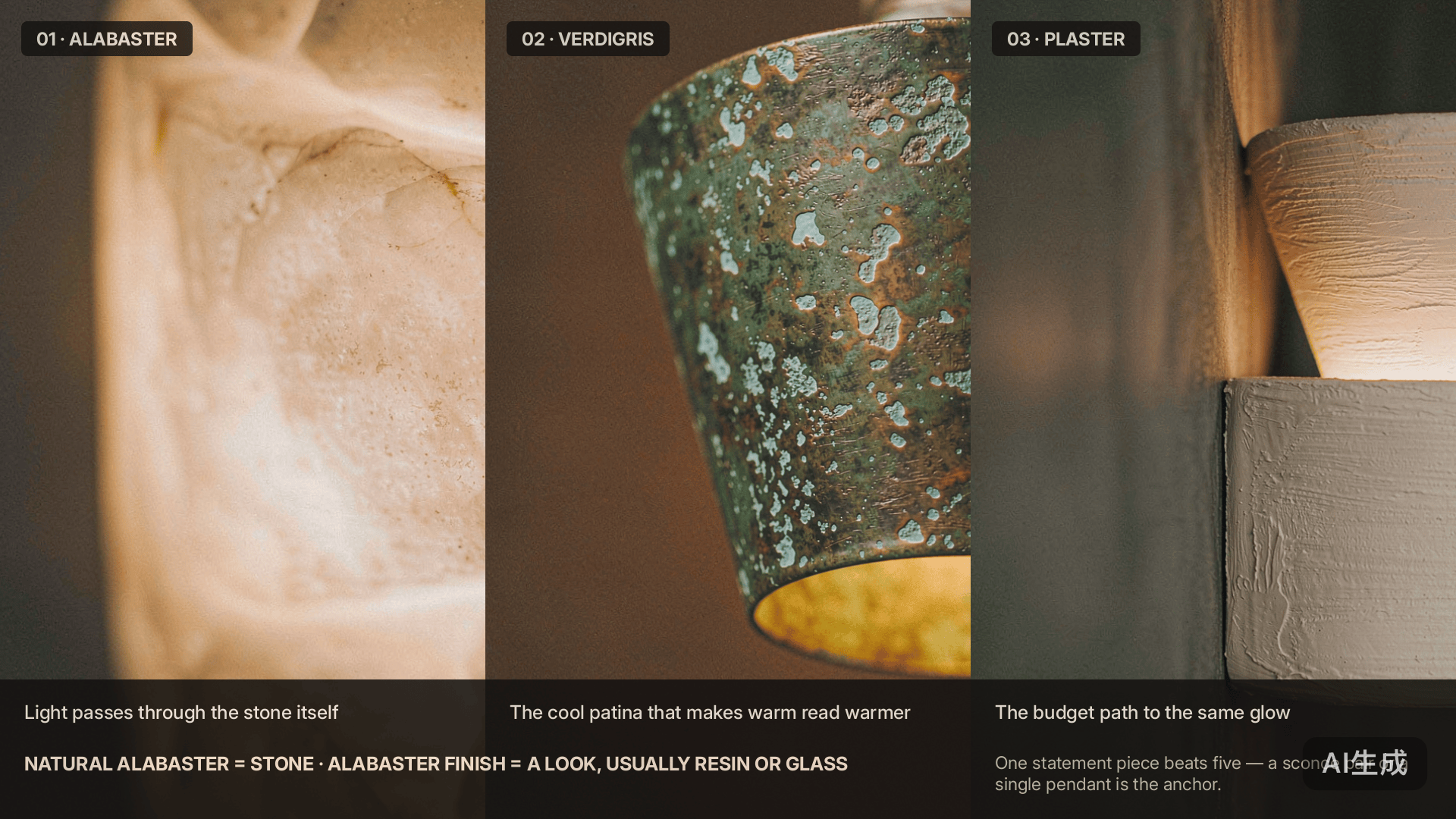
Designers call alabaster the stone that glows. It’s 2026’s quiet lighting trend — and the physics is why.
Alabaster is a translucent, fine-grained stone: light passes through the material itself, so a fixture glows softly instead of glaring. The wall behind it stays dim while the stone reads warm. Atlanta designer Theresa Ory, quoted in this year’s trend coverage: stone fixtures create “the most gloriously soft, luminescent glow.” London brand Jamb built a five-piece collection around it; Paris atelier Alain Ellouz has made the stone an entire practice — chandeliers, sconces, table lamps.
Two more materials riding the same wave:
Verdigris — the aged-copper patina. The green-blue finish that forms naturally on copper and brass went from garden-ornament detail to mainstream fixture finish this year, with several brands offering it on sconces and pendants. It flatters warm light: the patina’s cool green makes a 2700K bulb read warmer by contrast.
Plaster and gesso textures. Hand-troweled matte finishes that diffuse light with the same softness, and even large brands have added plaster-finish lines. The budget path to the same glow.
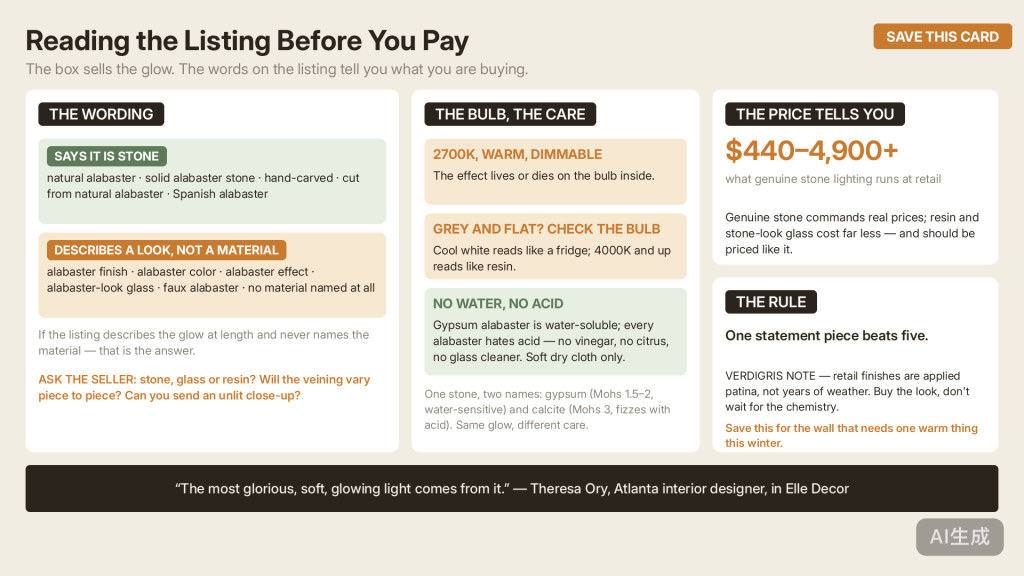
How to shop it without getting burned:
- Read the material line. “Natural alabaster” is stone; “alabaster finish” usually means painted resin. Both are legitimate — they just glow differently, and stone commands real prices.
- The bulb makes the stone. The effect depends on a warm bulb inside — 2700K or warmer, dimmable. A cool bulb through translucent stone looks like a fridge.
- One statement piece beats five. A sconce pair or one pendant is the anchor; scattering these finishes reads busy.
Save this for the wall that needs one warm thing this winter.
作者

admin@exmaple.com